WISDOM SNIPPET #6

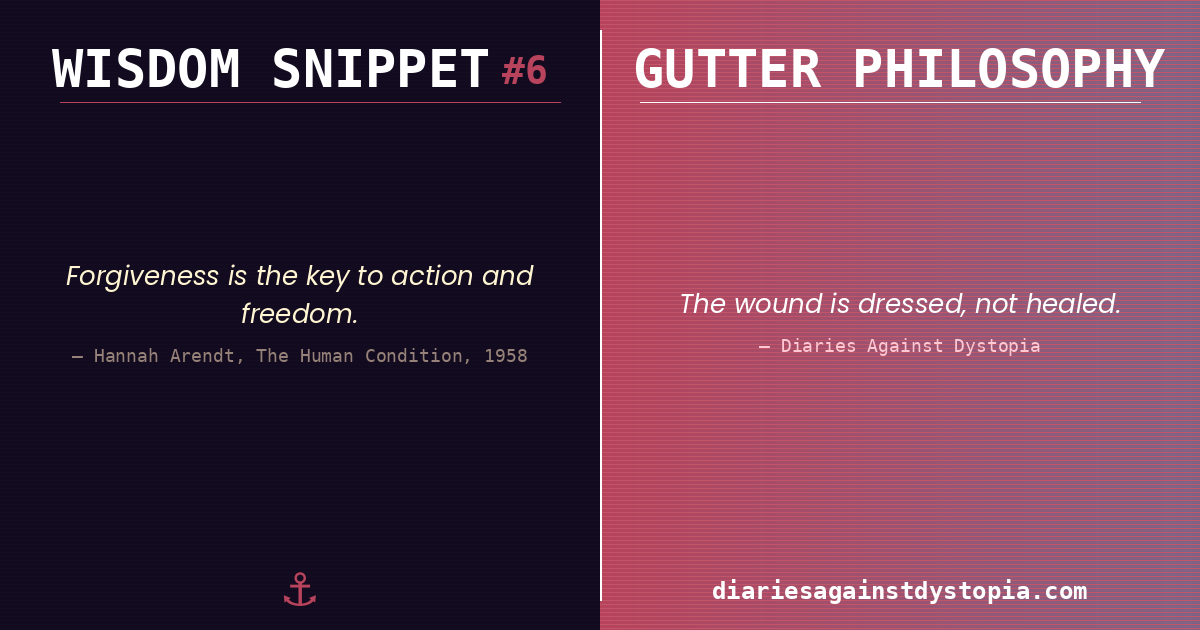
"Forgiveness is the key to action and freedom." — Hannah Arendt, The Human Condition, 1958
Gutter Philosophy
My quote generation machine, the one that feeds the Wisdom Snippets, came up with this Hannah Arendt quote while I was preparing for the Metallica shows in Frankfurt. Yes, I'm a fanboy, but I also admit that I kinda struggle to properly decipher James Hetfield's recurring fixation on forgiveness, manifested in the "Unforgiven" trilogy spanning nearly two decades, from the Black Album to Death Magnetic. Hetfield asks his audience to forgive themselves and of course I happily cheered with the crowd. I'll do that, Papa Het. Yet I still don't know how it exactly works.
Arendt wrote these words against the backdrop of something that's unforgivable. After she fled the Nazis and while she was still processing that she once was in love with the man who would go on to "philosophy-wash" the terror regime. Eichmann wasn't the Forschungsobjekt yet, but presumably her inner conflict was.
Luckily, the inner and outer struggles we all deal with, the flaws, the bad decisions, the misconduct, the contempt, the violence and chaos we struggle to forgive, aren't always Adolf-Eichmann-size evils, banal as they might be.
Forgiveness goes deeper than making peace with a situation. Peace is the condition in which forgiveness can flourish. The violence, the abuse, the trauma must be long over and settled. You can have lasting peace without ever forgiving.
Two World Wars and one World Cup, doo dah, doo dah.
English football fans have been chanting this at German opponents since roughly 1966, the year England won their only World Cup. On home soil, beating West Germany in the final. The chant is pure provocation. It's also, if you think about it, philosophically devastating. In light of the recent violence and the ever-growing hate against migrants, befeuert by the right-wing sycophants, the alumni of the "Steve Bannon School Of Politics", it's outright scary. No need to work on forgiveness, on overcoming traumas. We won, we're better than you, and we'll be better in ethnic cleansing than you. For a decent number of people, the Nazi time seems to look attractive today. They are seduced and Goebbels-ed by a greedy Epstein class who only have holes instead of souls. They know that their cash flows best on a paved Autobahn towards Auschwitz; and that they can never be forgiven.
For the rest of us, those who don't have friends with private islands, the trauma is contained, not resolved. The wound is dressed, not healed.
Arendt knew this. She lived in peace in New York. She never fully forgave Germany. She went back to cover Eichmann and wrote one of the most precise books ever written about evil. That's not forgiveness. That's something else. Reckoning, maybe. Cold retribution. She sezierte Eichmann and the Holocaust Supply Chain; the countless yay-sayers who knew they were doing wrong, but the boss is always right; the German, the human condition of "erst kommt das Fressen, dann die Moral", the kleingeistig, banal, lingering evil in the souls of the Hausfrau who currently has a triumphant return as tradwife; the Prussian bureaucrat who prefers order over anything, all these abysses we can all see in the mirror when we look close enough. That is what Hannah brought to light when slicing through the liver of the soulless but alive corpse who sat opposite her in the courtroom, representing "the normal people" who would come home to their loved ones and light-heartedly water their geraniums after a busy day separating the gold from the teeth. Or whatever their day job within the machine was. She cut open this corpse in stone-cold accuracy.
In that, she won the war. Dictated the peace and demanded reparations. But Hitler's Hooligans never admitted defeat. (Nor have the Commies, by the way. That might be a different story, but still. Hunger for power starves and kills people also under the guise of "true" socialism, and yes, in Stalin's case, approaching industry-scale destruction. But I would never question or weaken the singularity of the Holocaust. However, in terms of forgiveness this audacity might help to prove a point.) They are constantly rearing their ugly heads and breeding and shitting out their dipshit acolytes, hardening the route to forgiveness altogether.
Forgiveness is only possible under the condition that the wrongdoer seeks forgiveness. These folks still think they're on the right - ha! - side of history, just the execution was here and there a tad clumsy. They don't want to overcome the inner caveman. They want to reach for their cudgel and bludgeon everything they don't like to smithereens. Or, to put it more mildly, they cannot unlearn centuries-old biases and grievances. So, for me forgiveness is a term too infested with religious rigor.
But who am I to contradict Arendt and Hetfield?
Maybe what they mean is: you gotta forgive yourself the attitude towards certain situations. You can't forgive something? Forgive yourself doing just that. Forgive yourself that you have to overcome the shame, guilt, hate, fear, whatever you felt, and bury it somewhere in your soul.
It's always there.
But that's ok.
For me, this is still more acceptance than forgiveness. It might be the key to action and freedom, in the sense that acceptance allows you to move forward and let go, rather than being stuck in a situation that doesn't allow you to live in the now, but chains you to a past you have to live through over and over again.
But forgiveness? I still have to learn that, I guess.